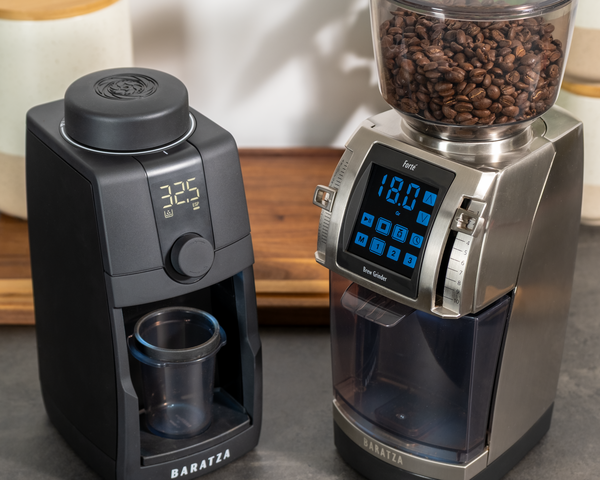
First, we’ll explore what makes a grinder stepped or stepless, and how these grind adjustments have factored into Baratza product design. Then, we’ll talk pros and cons of each design. Finally, we’ll go over how you might decide what level of precision is best for you and whether one type is actually better than the other.
Adjusting Your Grind
If you have a grinder that clicks when making grind adjustments, as most of our lineup do, then congratulations, you have yourself a stepped grinder. This simply means that there are physical, defined limits between each grind setting on your coffee grinder. Each grind adjustment moves the burrs a set distance closer or apart from each other, and that distance determines the size of your grind. Stepped adjustments are, especially for Baratza grinders, the most common type out there. Grind adjustments are highly consistent, easily adjusted between, and simple to keep track of. Setting 20 is always setting 20, so to speak. This does mean that some stepped grinders have far more adjustability than others and may be more suitable for different brew styles. The Encore has 40 stepped settings, each moving the burr an equal distance between steps. This means that while the Encore is excellent for filter brewing or French Press, it requires a greater deal of care to dial in espresso, as the perfect shot may lie in between two grind settings. There are a variety of levels of precision within this type of adjustment, based on how much the burr is moved between each grind setting.
Take the Forté BG, for example. This is a flat burr grinder, with one burr stationary, and the other which moves as the grind setting is adjusted. They are flat, so the grind adjustment directly moves the burr up and down as the each lever on the grinder are moved to adjust burr distance. There are two grind adjustments on this grinder, a macro setting and a micro setting. Just as they sound, the macro setting makes large adjustments and moves the burr a comparatively far distance, while the micro setting just barely moves the burr. This offers far more adjustability and precision to the grind setting than if it was just the macro setting alone, but the presence of the macro setting allows the burr to have a much farther range of adjustment compared to just having the small movements of the micro setting. These adjustments work in tandem to allow the grinder to have the full range of motion between espresso fine and cold brew coarse, while still allowing fine, precise adjustments to be made which are crucial for espresso. A few dozen microns, which are equal to one one-thousandth of a millimeter, of burr movement can mean a change of several seconds in your espresso shot time. The flexibility here makes this a very well-rounded, all-purpose grinder.
A stepless grind adjustment, on the other hand, can eliminate the need to have two grind adjustments as there are no physically delineated steps between grind settings. The grind adjustment is completely smooth, with one setting flowing directly into the next. On some grinders, this can be quite frustrating, especially if the grinder is being used for many types of grinding, and usually is not suitable for an all-purpose grinder (with an important caveat that we will get to!). This is because many stepless grinders do not include a notation on the machine for grind settings, or may require multiple, full revolutions of the grind adjustment in order to move between grind settings for different brew methods, making it difficult or frustrating to return to the previous grind setting used. This is because these grinders are typically single-purpose, usually specifically for espresso grinding. Since espresso drinkers typically adjust the setting based on how the previous shot pulled, only small grind changes are needed and these grinders are not made to jump around between major grind settings.
The precision gained from the very small, precision adjustments on a stepless grinder have been factored into our Sette series grinders, which have a hybrid style adjustment and are espresso-focused. Unlike the Forté BG, these have a cone-shaped burr and a ring-shaped burr. The grind adjustment acts as a screw, moving the burrs closer and further apart. They have macro and micro grind adjustments, like our flat burr grinders, but while the macro adjustment is stepped, the micro setting is stepless. This allows for a great deal of precision in fine-tuning a shot, while still making it easy to make large changes for different coffees or espresso brewing styles, but it does not have as wide a range as our flat burr grinders. Simply record the previously used grind setting and it is easy to switch back and forth.
The Problem of Simplicity
So, single stepped adjustments are good for larger grind size changes, while stepless adjustments are only good for smaller changes, right? Not always! The Encore ESP and the Encore ESP Pro turn these ideas on their heads. Both were designed to elegantly solve the problem of the precision needed for espresso, while keeping things as simple as possible. Let’s be honest; one grind adjustment is simpler to keep track of than two. How do they do it? By combining two grind adjustments into one.
The Encore ESP is a stepped grinder with a single grind adjustment, but with far greater precision than the Encore, with the goal of making espresso easy to dial in. Both of these grinders are conical grinders, like the Sette series, so their grind adjustments work like a screw to move the ring burr further away or closer to the cone burr. The Encore has a single ramp that the burr moves up and down on, so that, as mentioned earlier, each grind adjustment moves the burr a set distance. On the other hand, the Encore ESP has two pitches on this ramp. From settings 21-40, the filter range, this portion of the ramp is quite steep. This allows the burr to move between pour-over, French Press, and cold brew settings with ease. But on settings 0-20, the espresso range, this ramp is far shallower, meaning that each click moves the burr a very small amount, so that it is easy to make those fine adjustments needed for espresso brewing. With a combined grind adjustment like this, only a single number needs to be kept track of in order to adjust between espresso and filter coffee for a household that brews both.
Remember that caveat we mentioned earlier? That would be the Encore ESP Pro. This grinder’s grind adjustment was designed to expound upon the idea behind the Encore ESP to offer even more precision via a stepless adjustment, but while still being a capable all-purpose grinder. Not only does the Encore ESP Pro have 60 grind settings, with 0-40 dedicated to espresso, the grind adjustment is also completely stepless, eliminating the possibility of the perfect shot being in between grind setting steps. The portion of the ramp dedicated to espresso is both shallower and longer than it is on the Encore ESP, meaning that there would be a greater level of precision even if there were steps between grind settings, which there are not. And, on the display, grind settings are shown digitally in increments of 0.5, making it easy to remember what grind setting was used last when adjusting for a different brew method, even without defined clicks between settings. The Encore ESP Pro is truly, in our opinion, the meeting place of precision and ease of use for the all-purpose grinder.
Which Is Best for You?
With all that in mind, which type of grind adjustment is best for you? First, it is important to know what style of brewing you plan on doing. Do you only plan on brewing espresso? A Sette series grinder is likely best. While they do not have as wide of a grind range as the Forté BG, that is unimportant for a solely espresso brewer. The Sette grinders focus on precision within the espresso range, which is crucial for that brewing style. The Forté AP and Vario+ also excel here, with the same grind adjustment style as the Forté BG, and burrs that are made for espresso. Just doing pour-overs? That is where the Forté BG and Vario W+ shine, along with the Encore and Virtuoso+ for those who prefer a conical burr. The flat burrs here still provide high precision and adjustability, while their steel burrs are great for this brew method. Encore and Virtuoso+ grinders are also perfect for those who are just getting into home brewing or do not require the extreme level of adjustability that our flat burr grinders offer, like for those who prefer French press. If you switch between espresso and other brew methods, and especially if this is your first standalone burr grinder, that is where the Encore ESP and Encore ESP Pro show up best. The Forté and Vario+ series grinders are also excellent for all-purpose grinding and come with a variety of helpful features, but the combination of simplicity and precision in the Encore ESP and Encore ESP Pro cannot be beat for someone just entering the home brewing space.
Choosing a coffee grinder can be a big decision to make and there is a lot to learn in the coffee world. Is there a best grinder? That’s hard to say, but we believe that there is a best grinder for you out there, and we hope to empower you with the knowledge needed to make that decision. Knowing the level of adjustability you need, how simple you would like the process to be, and what style of brewing you plan on all factor heavily into the decision. Our aim is to help you get to the best cup of coffee as possible, every morning, and we believe one of our grinders will get you there.
We Grind. You Brew.
Related Articles
 Product Guides
Common Grinding Myths
Home coffee grinding has become increasingly sophisticated, and so have the conversations surrounding it. Product Guides
Dialing in Espresso
Once you understand espresso fundamentals, the next step is learning how to fine‑tune your grinder. Product Guides
Switching Grind Settings with Confidence
Switching grind settings is a crucial part of grinding coffee.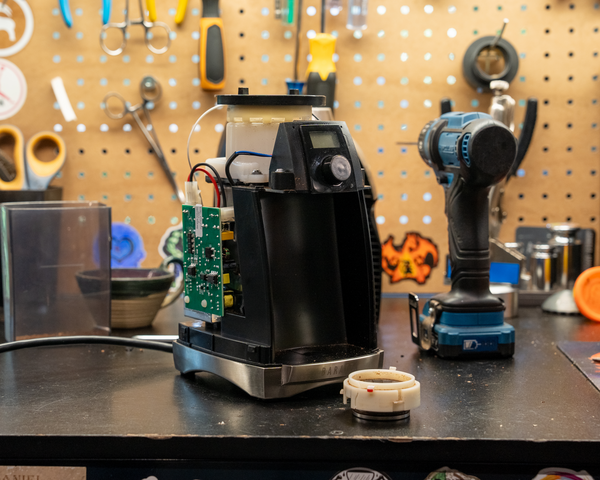 Product Guides
How We Keep Baratza Grinders Out of the Landfill
At Baratza, keeping grinders out of the landfill starts with how we design them.