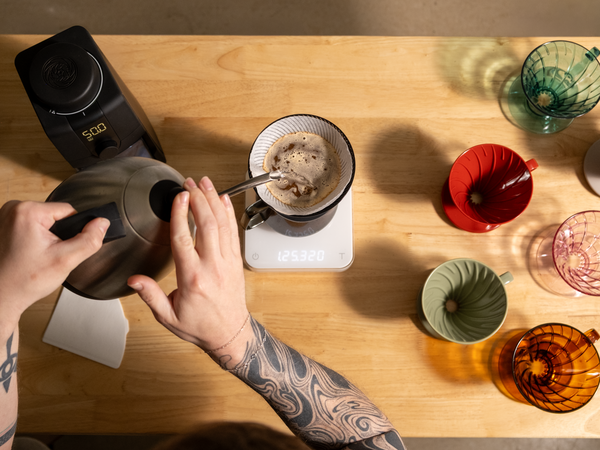
This guide is for home brewers who want a dependable starting recipe and a better understanding of how grind size, pouring style, and filter choice shape the final cup. Understand the technique, choose the right grind, brew with intention, then adjust based on taste.
Why the Hario V60 Produces Such a Clean Cup
The V60 is a pour-over brewer built around flow. Its 60-degree cone shape helps guide water through the coffee bed, while the large opening at the bottom allows the brewer to drain freely. This design gives you a lot of control over extraction, but it also means your grind size and pouring technique play a very important part, unlike an immersion brewing technique, like French Press.
Because water can pass through the V60 quickly, a consistent grind helps keep extraction even. Too fine, and the brew can slow down, clog, or taste hollow and overworked. Too coarse, and the water may pass through before it has extracted enough sweetness, leading to a weak, watery cup. Notably, it is much more difficult, in our experience, to grind too coarsely, but it is still a concern. When everything lines up, the V60 produces a cup that feels clear, balanced, and aromatic.
Choosing the Right Grind Size
A medium to medium-coarse grind is the best starting point for this recipe. For the coffee we used, which was on the lighter side, the grounds look a bit coarser than granulated sugar. If you are newer to pour-over brewing, it is usually easier to start a little coarser. A coarser grind is more forgiving, allows for more agitation during brewing, and can help prevent clogging.
A finer grind can work well for brewers who have a steady pour and a high-quality pouring kettle. It gives you more extraction potential, but it also requires more control to keep from clogging up the filter. Small changes in pouring speed or agitation can have a bigger effect.
In general, it is easier to adjust finer on subsequent brews than to keep chasing a stalled brew coarser and coarser. When in doubt, start slightly coarse, taste the result, then make one small adjustment at a time.
Starting Grind Settings
| Encore | Encore ESP | Encore ESP Pro | Virtuoso+ | Vario+ | Vario W+ | Forté AP | Forté BG |
|---|---|---|---|---|---|---|---|
| 23 | 25 | 50 | 23 | 9M | 8M | 9M | 8M |
These settings lean slightly coarser and were brewed using a lighter roast, which makes them a friendly place to begin. Your final setting may change depending on the coffee, roast level, filter paper, pouring style, and kettle, so do not be afraid to experiment. In particular, if you are using a dark roast, you may need to grind a bit finer than shown here, but these are still good places to start.
A Reliable, Everyday V60 Recipe
This recipe produces a clean, balanced cup, around 10 oz or 300 mL, and gives you room to refine based on taste.
| Coffee | 20 g |
|---|---|
| Water | 320 g at 210°F / 98°C |
| Total Brew Time | Under 3 minutes |
| Grind | Medium to medium-coarse |
- Heat your water to 210°F / 98°C.
- Grind 20 g of coffee at a medium to medium-coarse setting.
- Place your V60 filter in the brewer on top of your cup or carafe and rinse it thoroughly with hot water. Discard the rinse water.
- Add the coffee to the brewer and gently level the bed by shaking the brewer.
- Start your timer and pour 40 g of water, double the amount of coffee used, for the bloom.
- Immediately swirl or stir gently after pouring the bloom water to make sure all grounds are saturated.
- Let the coffee bloom for 30 seconds.
- After the bloom, add about 100 g of water, pouring slowly in concentric circles starting in the center and moving outward. Try not to pour on the filter itself, just on the ground coffee.
- Wait roughly 10 seconds between pours.
- Repeat the pour until you reach 320 g total water.
- Aim to finish the brew in under 3 minutes.
- Swirl your cup gently and enjoy.
This recipe should taste clean, sweet, and balanced. If your brew finishes around 2:30 and tastes good, there is no need to force it closer to 3 minutes. In testing, brews that finished even 30 seconds under 3 minutes still had a pleasant flavor.
Refining Your Pouring Technique
Pouring technique has a noticeable effect on V60 brewing and is where you can take your brew to the next level. A steady pour, making sure that all the coffee is being wetted evenly, helps extract flavor evenly. On the other hand, too much agitation, from pouring too high up or too quickly, can move fine particles through the coffee bed and toward the filter, ultimately clogging it.
In our experience, most brewers struggle with their brew taking too long and over-extracting the coffee. If your brew tends to take too long past the goal time, pour gently. Keep the tip of the pouring spout close to the coffee bed and pour slowly. This limits agitation and helps reduce the chance of clogging. Also, try not to let the coffee bed run dry during brewing. If this is happening in the ten seconds between pours, you may need to grind more finely next time. When the bed dries out, fine particles can migrate toward the filter and clog it. Once that happens, later pours may drip through very slowly, and the cup can taste hollow, bland, or generally unpleasant.
If your brew is moving too quickly, you can use technique to slow it down. Pour a little more aggressively or wait longer than 10 seconds between pours and allow the water to draw down almost completely before adding more. In this situation, it is actually helpful to have those fine particles clog up the filter just a bit, as they will keep water in contact with the rest of the bed for longer. That said, fast V60 brews are not as often a problem. Taste should guide your adjustments more than the timer alone, as a quick brew can still taste delicious.
Filter Paper Makes a Difference
Filter choice can change the cup more than many brewers expect. In our testing, thinner filter papers produced a more intense flavor. They also seemed less prone to clogging.
If your brew is running far beyond 3 minutes and grinding coarser does not solve the issue, try switching to thinner filter papers. This can improve flow and help preserve clarity without forcing you into an overly coarse grind.
Thicker papers can still work well, as the Chemex brews with famously thick filter papers, but they may slow the brew more than expected, especially with coffees that produce more fines or with a pouring style that creates more agitation.
Why Your Grinder Matters
The V60 relies on even flow through the coffee bed. A consistent grinder helps make that flow more predictable by reducing the mix of large boulders and tiny fines that can lead to uneven extraction. That said, different burr types have a noted effect on how your coffee looks when ground. Conical burrs, for example, can produce more fine particles compared to steel flat burrs due to how they break up the beans, but it does not mean they are unsuitable for this brewing. In fact, some of our favorite brews in testing came from the Virtuoso+, one of our conical grinders.
Regular grinder cleaning also helps keep flavors clear. Old grounds and coffee oils can dull sweetness and make it harder to understand what your adjustments are doing. A clean grinder equals a cleaner brew.
Troubleshooting Common V60 Issues
If Your Brew Takes Much Longer Than 3 Minutes
Try grinding slightly coarser. Move one or two grind settings coarser, or about 4 to 5 micro-clicks coarser on Baratza flat burr grinders. Do not be afraid to continue coarser, some coffees, especially lighter roasts, need a coarse grind.
Agitate the bed as little as possible when pouring, meaning pour delicately. Keep the pouring spout close to the coffee bed, pour slowly, and avoid stirring or swirling beyond the bloom. Make sure the bed does not run dry during brewing.
If the brew still slows down too much, thinner filter papers can help.
If Your Brew Tastes Hollow, Bland, or Unpleasant
This can happen when the brew slows down too much. The coffee may be spending too much time in contact with water, especially if the filter has started to clog.
Grind a little coarser, pour more gently, and avoid letting the coffee bed dry out. If coarser grinding does not help, look at your filter paper as a possible cause.
If Your Brew Drips Out Too Quickly
Grind a bit finer on your next brew. You can also pour more aggressively or wait longer between pours, letting the water draw down almost completely before adding more. This can increase total brew time and encourage more extraction.
In testing, V60 brews rarely drained too quickly. A brew that finishes under 3 minutes can still taste clean and balanced, so let flavor guide the adjustment.
If Your Brew Tastes Sharp or Underdeveloped
Grind slightly finer. You can also pour with a bit more energy to increase agitation or extend the pauses between pours to increase total brew time.
Make one change at a time so you can taste the effect clearly.
If Your Brew Tastes Bitter or Heavy
Try grinding coarser, pouring more gently, or reducing agitation after the bloom. A stalled brew can sometimes taste both over-extracted and strangely flat, so pay attention to drawdown time as well as flavor.
Bringing It All Together
The Hario V60 is simple, expressive, and rewarding. It gives you enough control to highlight delicate coffees, but it can also be forgiving when you start with a slightly coarser grind and a steady recipe.
Brew thoughtfully, practice your technique, and let the taste of each cup guide you to the next.
We grind. You brew.
Related Articles
 Brew Guides
AeroPress Brew Guide
The AeroPress is one of the most adaptable brewers available to home coffee enthusiasts. Brew Guides
Chemex Brew Guide
The Chemex is one of the most iconic brewers in the world of specialty coffee.